

I spent years hiding what happened at the cross.
Not literally—I mean in my writing, in early drafts of Becoming James. I wanted to skip past that moment where James denies his brother Jesus. Get to the transformation faster. The redemption. The part where he becomes the leader everyone remembers.
But the story kept pulling me back to that moment. To James in the crowd of onlookers, face turned away, trying to disappear among strangers while his brother died. To the soldier asking, “Are you kin to that one?” To James shaking his head. Lying. Then—and this is the part that haunted me—redirecting the soldiers elsewhere. Not just saving himself, but actively putting others at risk to make his denial believable.
That's not just saving himself. That's throwing others to the wolves.
And it’s the most important moment in the entire book.
Failure as Foundation
Here’s what I learned writing James’s story: transformation doesn’t happen despite failure. It happens because of it.
James doesn’t become a leader by getting everything right. He becomes one by facing what he got catastrophically wrong. By carrying the weight of his denial for thirty years. By building a community not from a position of moral authority but from the raw honesty of someone who knows what it costs to fail someone you love.
The early Christian community trusted James precisely because he didn’t pretend. He couldn’t. His denial was too public, his shame too fresh. So instead of offering certainty, he offered something rarer: the courage to keep showing up anyway.
That’s what failure teaches. Not humility in the abstract. Humility as lived experience…. the kind that makes you gentle with other people’s doubts because you remember your own.
Doubt as Companion
The hardest part of writing James was resisting the urge to resolve his doubt too quickly. I struggled with this all the time.
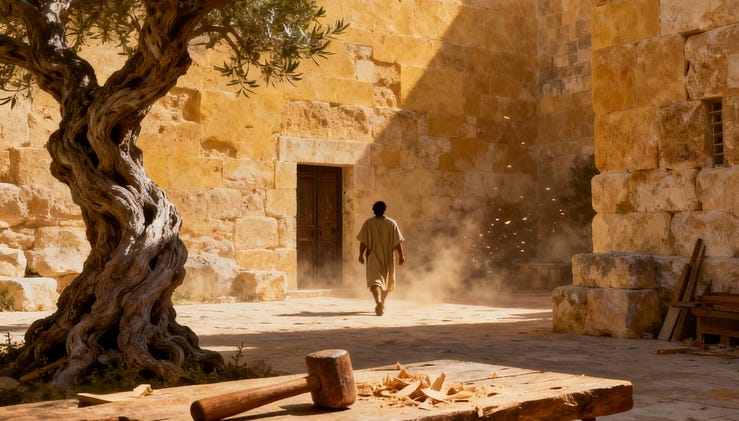
Peter sees the resurrected Jesus. Mary Magdalene sees him. Eventually five hundred others see him. But James? James finds an empty tomb. He sees something in the garden he can’t explain. He discovers a carved wooden lamb his brother made him years before, inscribed with words that feel like permission to question.
And then he has to decide: What do you do with evidence that points toward something impossible?
Traditional religious narrative says you either believe or you don’t. Faith or doubt. Pick a side.
But James’s story taught me something different. He doesn’t resolve his doubt. He acts within it. He opens his workshop to gatherings even though he’s not sure what he believes. He helps people even though he can’t explain the resurrection. He builds community not because he has answers but because people need somewhere to belong while they figure out their own questions.
Doubt, in James’s story, isn’t the enemy of faith. It’s faith’s necessary companion. It keeps faith honest. It prevents certainty from calcifying into cruelty. It allows for the possibility that what you believe today might deepen tomorrow.
The Cost of Visibility
By the end of the novel, James makes a choice that defines everything: he refuses to hide anymore.
The temple authorities are watching. People are being arrested. His community is being documented, names recorded, consequences mounting. Everyone around him is urging safety—close the door, scatter, wait until the danger passes.
And James says no.
Not because he’s finally certain. Not because his doubt has vanished. But because hiding—choosing safety over truth—nearly destroyed him once. He can’t do it again.
That’s the transformation. Not from doubt to certainty. From cowardice to courage. From hiding behind rocks to standing visible, knowing exactly what it might cost.
Why This Story Still Matters to Me
I wrote Becoming James after my brother died. After spending years avoiding the hard questions about faith, meaning, what remains when everything you thought was solid collapses.
James’s story gave me permission to ask those questions out loud. To admit I didn’t have answers. To build something anyway—not from certainty but from the stubborn insistence that showing up matters even when you don’t know what comes next.
Failure taught James that transformation doesn’t require perfection. Just willingness.
Doubt taught him that faith doesn’t mean having all the answers. It means choosing to live as if love matters more than fear, even when you’re not sure.
Those lessons are the ones I needed. The ones I’m still learning.
And I think they might be the ones a lot of us need right now.
Becoming James releases in 2026. It’s a story about the brother who hid, the leader he became, and the thirty years between cowardice and courage. If you live in the tension between doubt and hope—if you’re trying to figure out what to build after everything breaks—this story is for you.